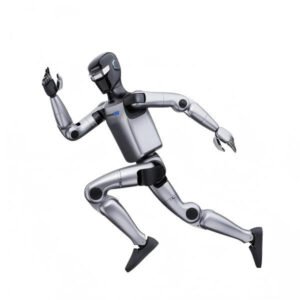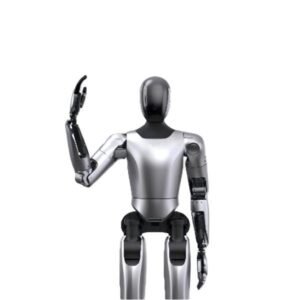
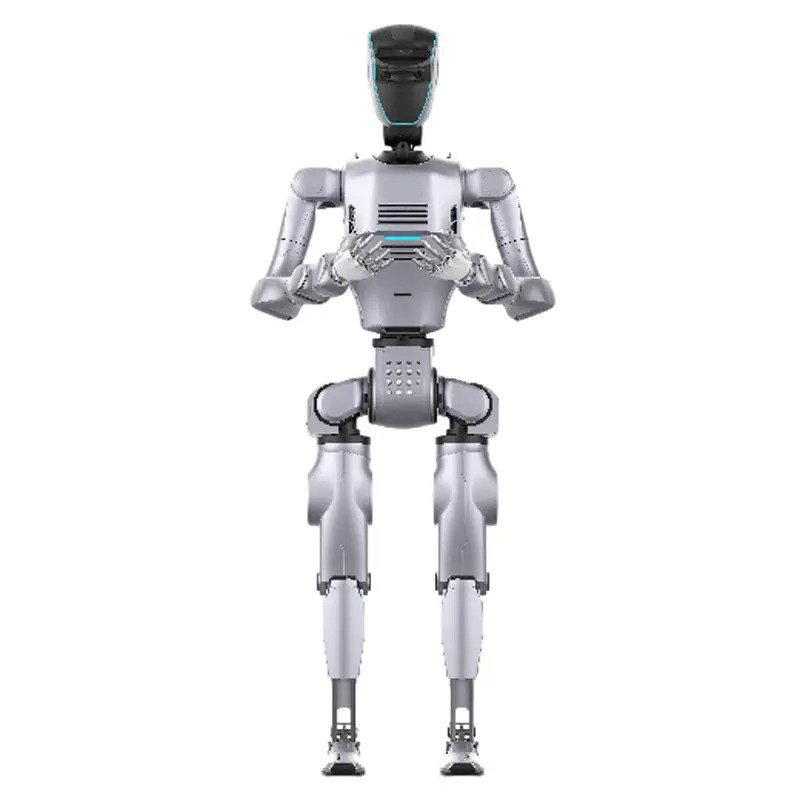
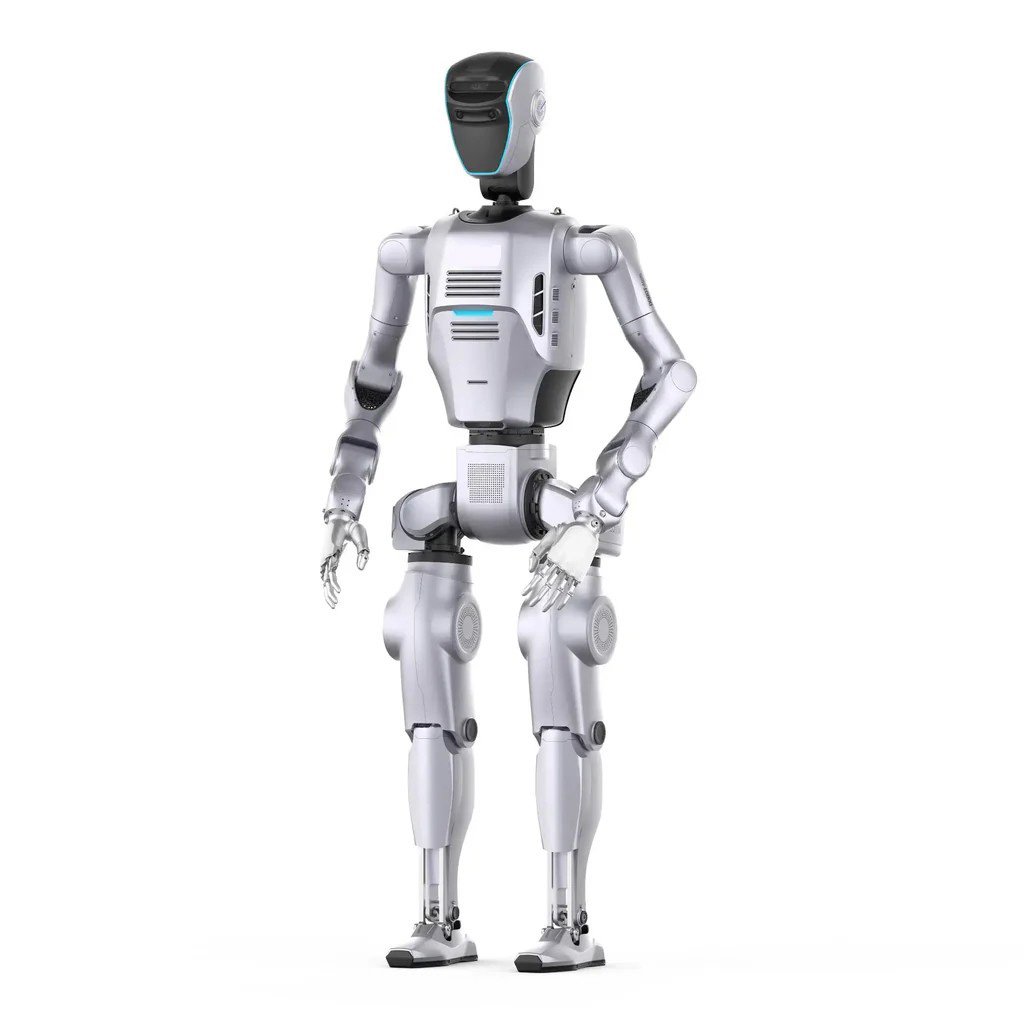
The Atom Max Research Humanoid Robot is a full-scale embodied AI humanoid robot developed by for advanced research institutions and demanding industrial deployments. The platform integrates precise dexterous manipulation with natural bipedal locomotion, allowing it to operate across unstructured environments without fixed workstation constraints. Its dual industrial-grade bionic arms deliver the positioning precision required for tool use, assembly, and multi-specification material handling across a range of human workstation heights. Designed to bridge laboratory development and real-world deployment, the robot supports scenarios from automotive assembly lines to pharmaceutical dispensing and precision manufacturing workflows.
The robot leverages a multi-layered AI architecture combining an onboard neural network motion system with a cross-scenario task model trained through both imitation and reinforcement learning. A comprehensive sensor array covering the head, wrists, and waist delivers full spatial awareness, enabling real-time obstacle detection and manipulation feedback at the end effector level. Built-in omnidirectional audio and speech capabilities allow the robot to interact naturally within human-occupied environments and respond to verbal input. The platform supports full SDK access, open-source model training frameworks, and VR/MR teleoperation, making it well-suited for research teams, system integrators, and enterprises building production-ready AI robotics applications.
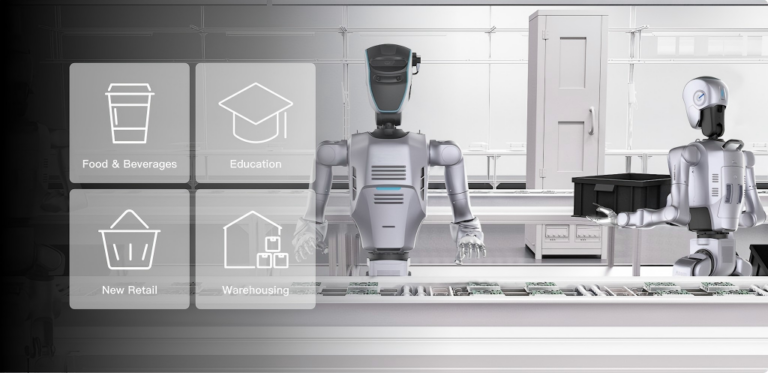
Core Highlights
Neural Driving System (NDS)
- Transformer-based architecture with binocular vision, 200Hz high-frequency control with servo-level anti-tremor
Anthropomorphic Straight-Knee Walking (AWS)
- Natural, energy-efficient straight-knee gait control
Multi-Robot Collaboration
- 7x industry-standard edge computing power for seamless human-robot teaming
Embodied AI ROM-1 Model
- Multi-scenario generalization, reduces pre-programming needs
Industrial-Grade Arm Precision
- 7-DOF arm with ±0.05mm accuracy for fine assembly tasks
360° Environmental Perception
- RGB-D + HD binocular vision + 3D LiDAR
Technical Specifications
| Product Model | ATOM Max (Flagship) | ATOM Trainer | ATOM Standard | ATOM D (Data Acquisition) |
| Height | Approx. 1650 mm | Approx. 1650 mm | Approx. 1650 mm | Approx. 650 mm |
| Weight (Excluding Dexterous Hands/Grippers) | Approx. 62 kg | Approx. 62 kg | Approx. 52 kg | Approx. 20 kg |
| Total Degrees of Freedom (DoF) (Excluding Dexterous Hands/Grippers) | 29 | 29 | 20 | 16 |
| Head DoF | 2 | 2 | 0 | 2 |
| Single Arm DoF (Excluding Dexterous Hands/Grippers) | 7 | 7 | 4 | 7 |
| Waist DoF | 1 | 1 | 0 | 0 |
| Single Leg DoF | 6 | 6 | 6 | 0 |
| Arm Span (Excluding Dexterous Hands/Grippers) | 600 mm | 600 mm | 600 mm | 600 mm |
| Single Arm Weight (Excluding Dexterous Hands/Grippers) | Approx. 6.5 kg | Approx. 6.5 kg | Approx. 4.5 kg | Approx. 6.5 kg |
| Single Arm Payload (Excluding Dexterous Hands/Grippers) | 3.5 kg | 3.5 kg | 3 kg | 3.5 kg |
| Arm Repeatability | ± 0.05 mm | ± 0.05 mm | ± 0.05 mm | ± 0.05 mm |
| Max Arm Tip Speed | 1.5 m/s | 1.5 m/s | 1.5 m/s | 1.5 m/s |
| Audio Equipment | 360° pickup microphone * 1 + Neodymium magnet speaker * 2 | 360° pickup microphone * 1 + Neodymium magnet speaker * 2 | 360° pickup microphone * 1 + Neodymium magnet speaker * 2 | – |
| Max Walking Speed | 1.5 m/s | 1.5 m/s | 1.5 m/s | – |
| Hollow Wiring in All Joints | Yes | Yes | Yes | Yes |
| Basic Computing Power | Intel i5 | Intel i5 | Intel i5 | Intel i5 |
| High Computing Power Module | Intel i9 (24 Cores 32 Threads) + Discrete GPU (FP32 GPU Computing Power: 41.15 TFLOPS) | Intel i9 (24 Cores 32 Threads) + Discrete GPU (FP32 GPU Computing Power: 41.15 TFLOPS) | 0 | 0 |
| Battery Life | Approx. 2 hours | Approx. 2 hours | Approx. 2 hours | – |
| Charging | Approx. 1 hour | Approx. 1 hour | Approx. 1 hour | External Power Supply |
| End Effectors | 6-DoF Dexterous Hand * 2 | 0 | 0 | 0 |
| Head Sensors | Depth Camera * 1 + HD Binocular Camera * 1 | Depth Camera * 1 + HD Binocular Camera * 1 | 0 | Depth Camera * 1 + HD Binocular Camera * 1 |
| Wrist Sensors | Depth Camera * 2 | Depth Camera * 2 | 0 | 0 |
| Waist Sensors | Depth Camera * 2 | Depth Camera * 2 | 0 | 0 |
| Head LiDAR | 3D LiDAR * 1 | 3D LiDAR * 1 | 0 | 0 |
| Secondary Development | Supported | Supported | Supported | Supported |
| Warranty | 1 Year | 1 Year | 1 Year | 1 Year |
| Technical Support | Premium support services, exclusive training, and complete development manual | Basic support services, complete development manual | Basic user guide and Q&A service | Premium support services, complete development manual, and ecosystem support |
| Onsite Technical Training | Yes | No | No | No |
| Remote Service | 3 times / year | 3 times / year | 0 | 3 times / year |
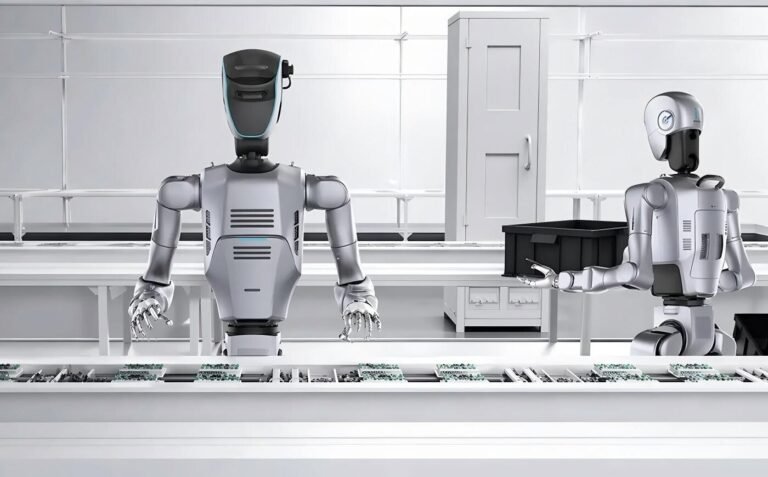
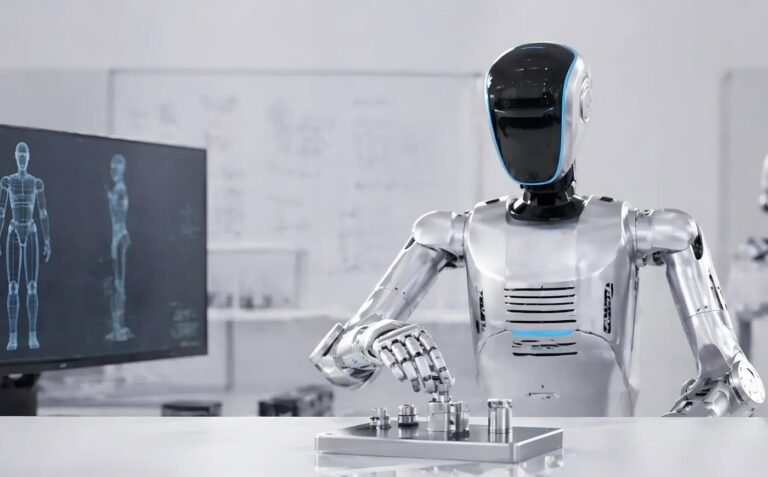
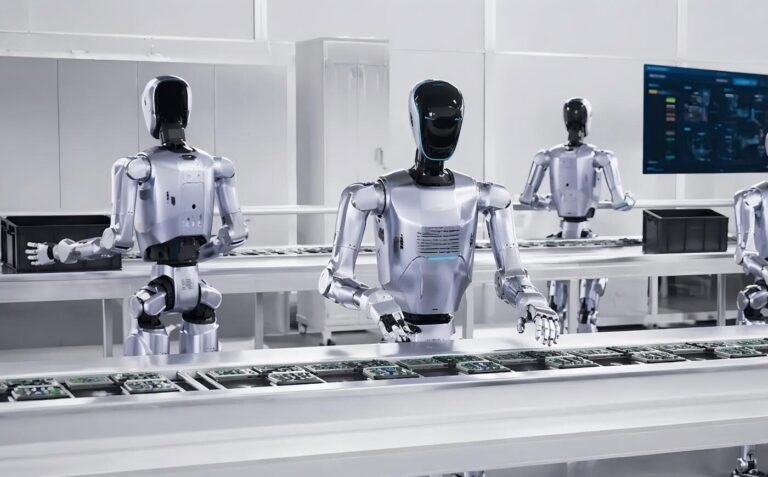
Applicable Industries
Industrial Manufacturing | New Retail | Healthcare/Pharmacy | Logistics & Warehousing |
 |  |  |  |
FAQ
Q1:Does ATOM Standard support walking?
Yes. ATOM Standard supports basic walking and upper-body interaction for humanoid robot entry-level experience, interactive demonstrations, and foundational development.
Q2:Does the ATOM Series support SDK development?
Yes. ATOM Max and ATOM D support SDK development for robot control, visual data processing, teleoperation, model training, and embodied AI application development.
Q3:Are all modules included in every configuration?
Not necessarily. Dexterous hands, grippers, wrist cameras, embodied AI development tools, AI computing modules, and teleoperation configurations may vary by version and project requirements. The final model, end-effectors, sensors, software access, and packing list should be confirmed before ordering.
Q4:Which model is suitable for industrial manipulation research?
ATOM Max is more suitable for industrial-grade precision manipulation, dual-arm collaboration, dexterous-hand applications, teleoperation, and complex task research.
Q5:Which model is suitable for AI data collection?
ATOM D is more suitable for large-scale manipulation data collection. Its dual 7-DOF arms, depth camera, binocular vision, Ethernet connectivity, and configurable end-effectors support embodied AI training workflows.
Customer Case