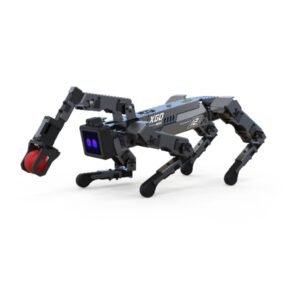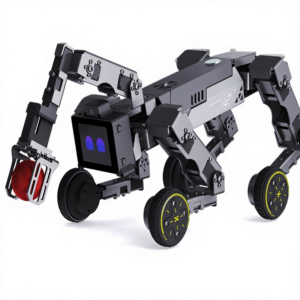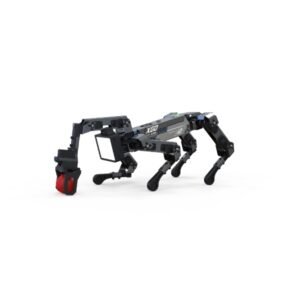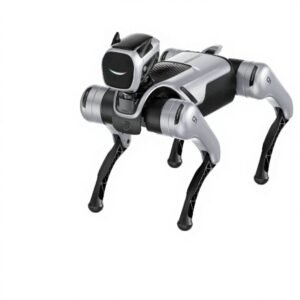

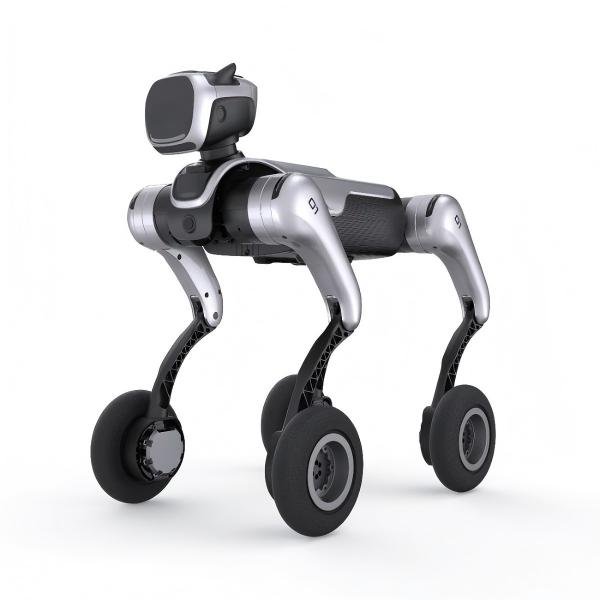
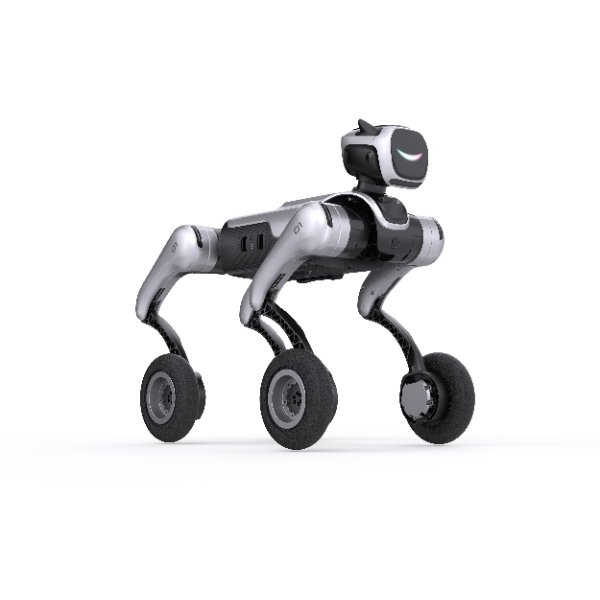
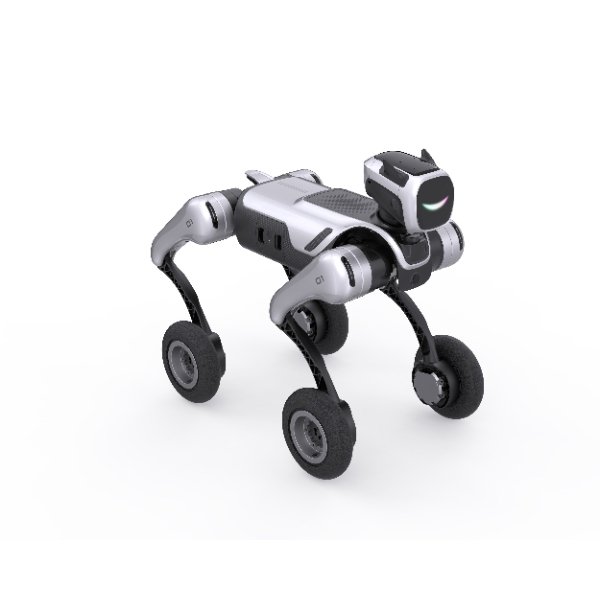
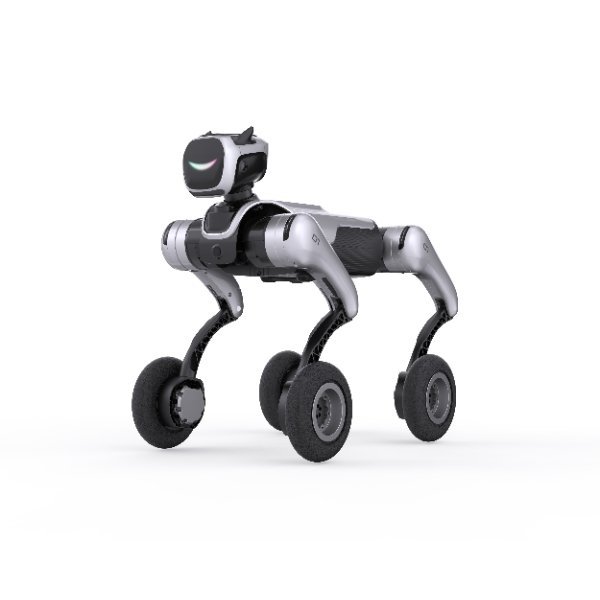
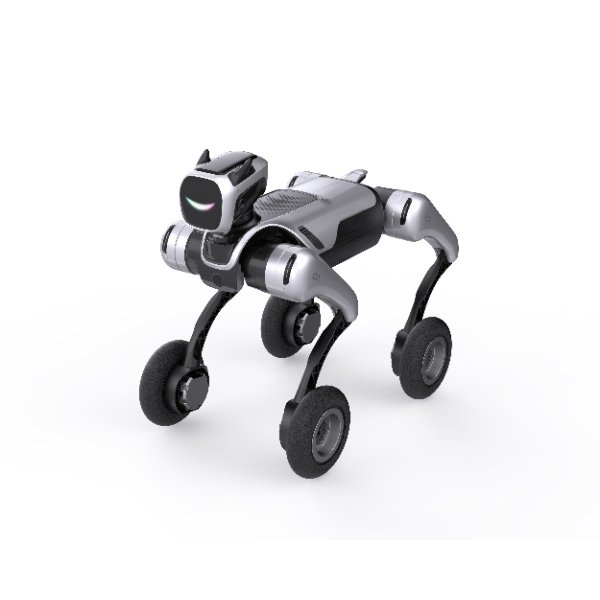
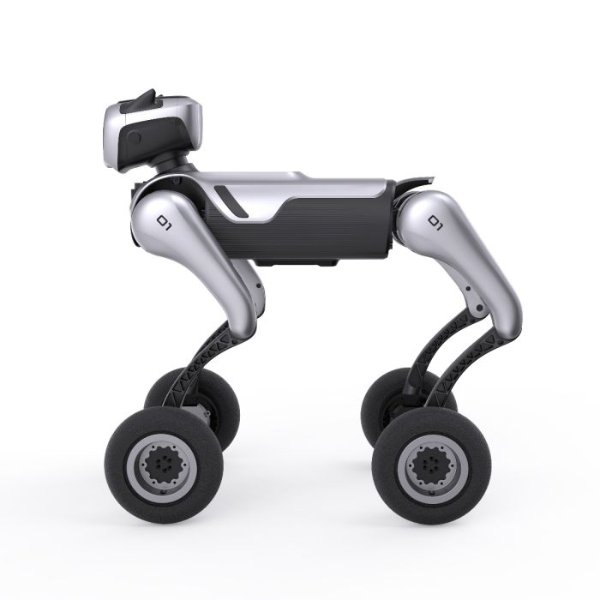
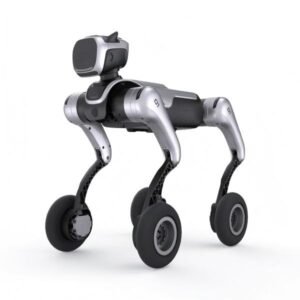
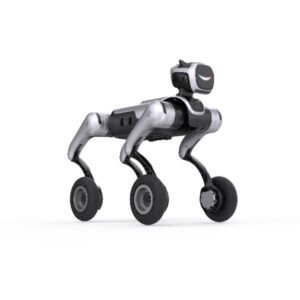
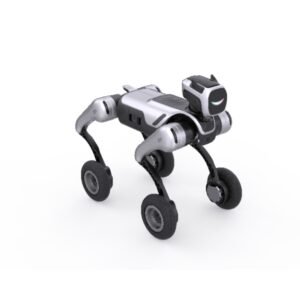
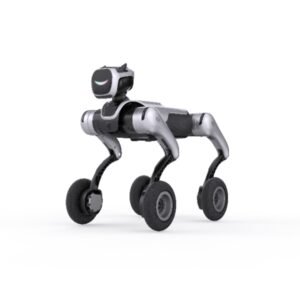
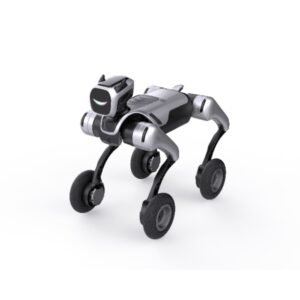
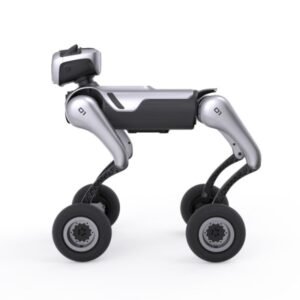
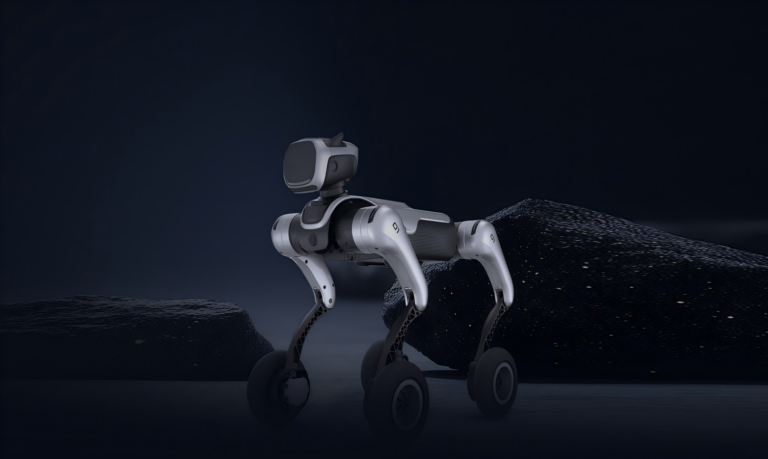
The MagicLab MagicDog‑W represents the pinnacle of quadruped robotics, combining cutting-edge AI technology, precise engineering, and interactive capabilities into a versatile platform suitable for research, education, and entertainment. Designed for both beginners and advanced users, this quadruped robot opens new possibilities in STEM learning, robotics competitions, and innovation labs worldwide.
Core Highlights
Wheeled-Legged Dual Drive
MagicDog-W combines wheel drive with quadruped leg motion. It integrates the efficiency of wheeled movement with the obstacle-crossing capability of legged locomotion, allowing switching between rolling and quadruped gait according to terrain conditions.
Smooth Motion Across Changing Terrain
During switching between wheel and gait modes, MagicDog-W supports continuous movement and posture adjustment for terrain-adaptation research on uneven ground, slopes, grass, and irregular surfaces.
Bidirectional Climbing and Reverse Motion
The supplied materials show forward, reverse, and terrain-adaptive movement. By combining quadruped joints with wheel drive, the robot can be used for slope movement, obstacle navigation, and bidirectional motion-control experiments.
Intelligent Posture Control
MagicDog-W features multi-joint motion, posture sensing, and control capabilities for body posture adjustment, dynamic balancing, inverted-pose demonstrations, and complex motion-control research.
LiDAR and Multi-Camera Perception
The Education Edition specifications list 2D LiDAR, 3D LiDAR, a 4K camera, stereo camera, ultra-wide camera, depth camera, ultrasonic sensors, and touch sensors for environmental perception, vision recognition, mapping, and navigation research.
Technical Specifications
| MagicDog-W | |||
| Primary Category | Sub-Category / Component | Parameter Item | Description (English) |
| Basic Information | Model | Navigation Edition | |
| Material Info | Aluminum alloy + High-strength engineering plastics | ||
| Dimensions (L x W x H) | Standing: 67cm * 35cm * 65cm Crouching: 72cm * 50cm * 29cm | ||
| Net Weight (Excl. Battery) | 22.5kg | ||
| Electrical Parameters | Battery Capacity | 8200mAh | |
| Battery Voltage | 29.6V | ||
| Processor Chip | 8-core processor | ||
| 4G | Pluggable SIM card | ||
| Wi-Fi | WiFi 5.0 | ||
| Bluetooth | BT 5.0 / 4.2 / 2.1 | ||
| Storage Space | 64G | ||
| Output Power | DC 28.8V (Battery voltage) | ||
| Battery Life / Endurance | 2 ~ 4 hours | ||
| Connectivity | RJ45 Ethernet port | ||
| Mechanical Parameters | Wheel Type & Size | 7-inch pneumatic tires | |
| Number of Motors | 16 + 1 (Head motor) | ||
| Head Rotation Angle | ≥ 100 degrees | ||
| Max Joint Torque | 37.5 N.m | ||
| Payload | Max 10 kg | ||
| Moving Speed | 0 – 3 m/s | ||
| Min Obstacle Clearance Height | < 60 cm | ||
| Max Slope Climbing Angle | ≤ 40° | ||
| MIC Array | Yes | ||
| Sensors | 2D LiDAR | Model | STL-19P |
| 2D LiDAR | Measurement Range | 0.03 – 12 meters (Tested with 80% reflectivity white target) | |
| Ranging Accuracy | ±30mm @ 2-12m (White target) Standard deviation: 15mm | ||
| Scanning Frequency | Min 6 Hz, Typical 10 Hz, Max 13 Hz | ||
| Ranging Frequency | 5000 Hz (Fixed frequency) | ||
| Pitch Angle Error | Min 0.5°, Max 2° | ||
| Yaw Angle Error | Min -1°, Typical 0°, Max 1° | ||
| Angular Resolution | Typical 0.72° @ 10 Hz | ||
| Anti-Environmental Light Ability | Max 60 KLux | ||
| Radar Noise | Typical 45 dB | ||
| Lifespan | 10000 hours | ||
| Working Temperature | -10°C to 45°C | ||
| Storage Temperature | -30°C to 70°C | ||
| Protection Rating | IP5X | ||
| 3D LiDAR | Model | Livox Mid-360 | |
| Measurement Range | 40m @ 10% reflectivity 70m @ 80% reflectivity | ||
| Ranging Accuracy | ± 2 cm | ||
| Ranging Rate | 200,000 points/sec (First return) 480,000 points/sec (Dual/Triple return) | ||
| Field of View (FOV) | Horizontal: 360° Vertical: 59° (-7° to 52°) | ||
| Angular Resolution | Horizontal: 0.18° – 0.36° (@ 10Hz) Vertical: < 2° | ||
| Near Blind Zone | 0.1 m | ||
| Data Interface | 1Gbps Ethernet | ||
| Laser Wavelength | 905 nm | ||
| Laser Safety Class | Class 1 (IEC60825-1:2014) | ||
| Anti-Environmental Light Ability | 100 klx | ||
| Radar Noise | 40 dB @ 10 cm | ||
| Lifespan | > 16000 hours | ||
| Working Temperature | -20°C to 65°C | ||
| Storage Temperature | -40°C to 85°C | ||
| Protection Rating (IP) | IP67 | ||
| Dimensions | 75 × 65 × 51 mm | ||
| Weight | Approx. 265 g | ||
| Supply Voltage | 10V – 17V DC | ||
| Power Consumption | Typical: 7.5W, Peak: 10W | ||
| Time Synchronization | IEEE 1588-2008 (PTP V2) | ||
| 4K Camera | Image Sensor | 1/3.06-inch CMOS Sensor | |
| Max Resolution | 3840H × 2880V | ||
| Pixel Size | 1.12um * 1.12um | ||
| Exposure System | Auto Exposure | ||
| Electronic Shutter | Global shutter | ||
| Interface Speed | 480MB/S (USB2.0) | ||
| Working Temperature | 0°C to 60°C | ||
| Storage Temperature | 0°C to 65°C | ||
| Focal Length | 2.22MM | ||
| Field of View (FOV) | D:117° H:94.8° V:76.7° | ||
| Distortion | <10.3% | ||
| Spectral Characteristics | No IR (No filter) | ||
| Aperture (F-No) | 2.2 ± 5% | ||
| Binocular Camera | Image Sensor | 1/4-inch CMOS Sensor | |
| Max Resolution | 2560H × 720V | ||
| Pixel Size | 3.0um * 3.0um | ||
| Signal-to-Noise Ratio (SNR) | 38dB | ||
| Dynamic Range | 63.9dB | ||
| Exposure System | Auto Exposure | ||
| Electronic Shutter | Global shutter | ||
| Interface Speed | 480MB/S (USB2.0) | ||
| Working Temperature | 0°C to 50°C | ||
| Storage Temperature | 0°C to 60°C | ||
| Connection Interface | 5-pin 1.25mm USB2.0 | ||
| Image Display Direction | Upright image | ||
| Focal Length | 3.15MM | ||
| Field of View (FOV) | D:162° H:135° V:73° | ||
| Distortion | <14.3% | ||
| Spectral Characteristics | 650nm Optical filter | ||
| Aperture (F-No) | 2.35 | ||
| Ultra-wide-angle Camera | Module Model | ZV-A0588-V5.1 | |
| Module Size | 32.00mm × 32.00mm × 15mm | ||
| Working Temperature | -30°C to 80°C | ||
| Storage Temperature | -10°C to 60°C | ||
| Camera Board Assembly Tech | SMT (ROHS) | ||
| Shortest Focus Distance | 30CM ~ Infinity | ||
| Supply Voltage | USB_5V | ||
| Connection Interface | USB 2.0 5P 1.25mm spacing SMD vertical | ||
| Power | MAX 1W, Current 140mA – 160mA | ||
| Operating System | Win XP, Win 7, Linux 2.6.20 or above | ||
| Packaging | Anti-static tray | ||
| Sensor Type | (1/2.7″) | ||
| Max Effective Pixels | 2 Megapixels (WDR) | ||
| Maximum Dynamic Range | 85dB | ||
| Pixel Size | 3.0um x 3.0um | ||
| Lens Type | 1/2.7 inch | ||
| Lens Structure | 6G + IR | ||
| Aperture (F-No) | 2.0 | ||
| Effective Focal Length | 2.0mm | ||
| Field of View (FOV) | D:200° H:200° V:200° | ||
| Distortion | 110% | ||
| Filter Piece | 650 ± 10nm | ||
| Gain / Exposure / Balance | Auto | ||
| Depth Camera | Dimensions | 124mm * 29mm * 26mm | |
| Min Sensing Distance | 0.105 meters | ||
| Depth Image Resolution | 1280*720 @ 30fps | ||
| RGB Resolution | 848*480 @ 90fps | ||
| Depth Field of View (FOV) | 86° * 57° (±3°) | ||
| Other Sensors | Ultrasonic Sensor | Yes | |
| Touch Sensor | Yes | ||
| Accessories | Optional Remote Controller | T12 / Beidou | |
| Extension Module | Standard Computing Power Module (Orin NX 137 TOPS) | ||
| Charger | Standard (33.6V 6A) | ||
| Functions | Secondary Development [2] | Programming Languages | C++ / Python |
| Secondary Development [2] | API | Robot Control Service High-level Motion Control Service Low-level Motion Control Service Sensor Control Service Voice Control Service Status Monitoring Service SLAM Navigation Control Service | |
| OTA Upgrade | Supported | ||
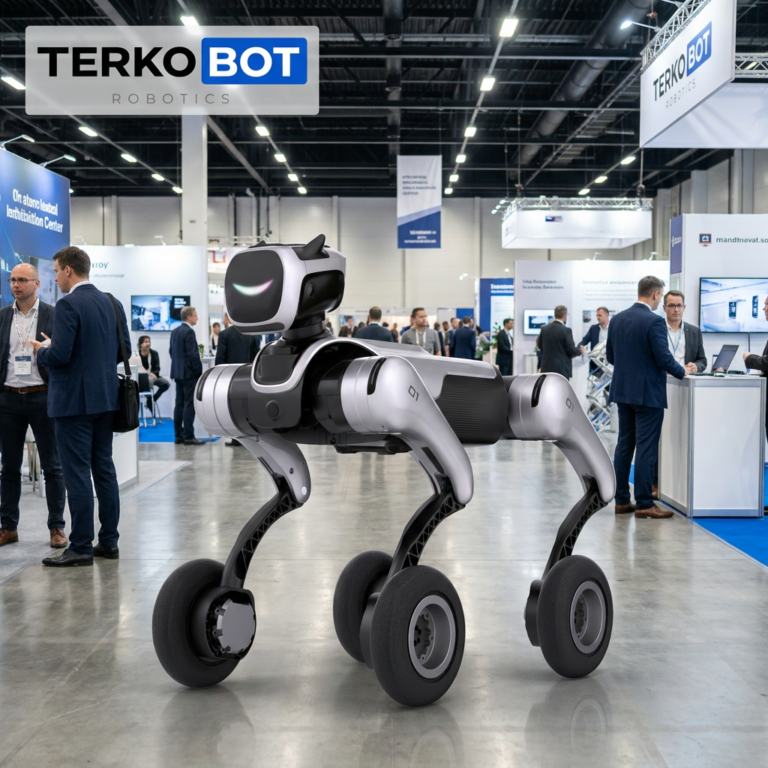
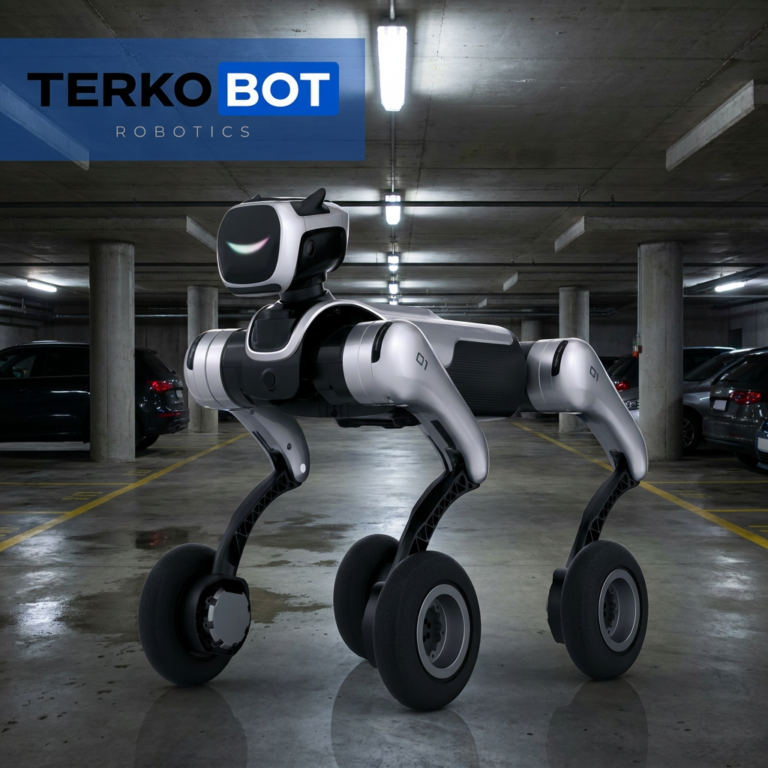
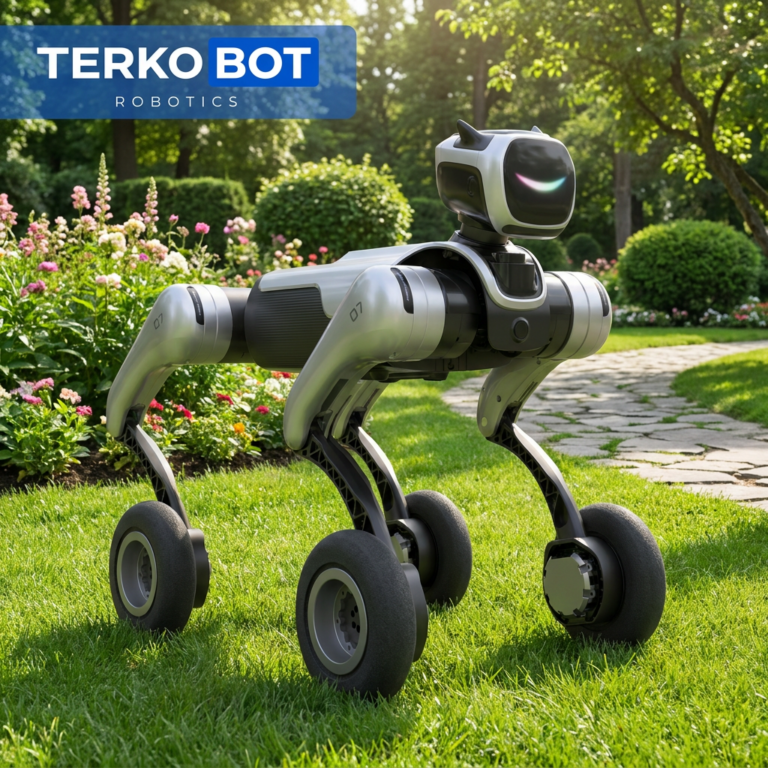
Application Scenarios
| Exhibition | Garage | Port | Garden |
 |  |  |  |
| Mountainous area | Storehouse | Mine tunnel | Hospital |
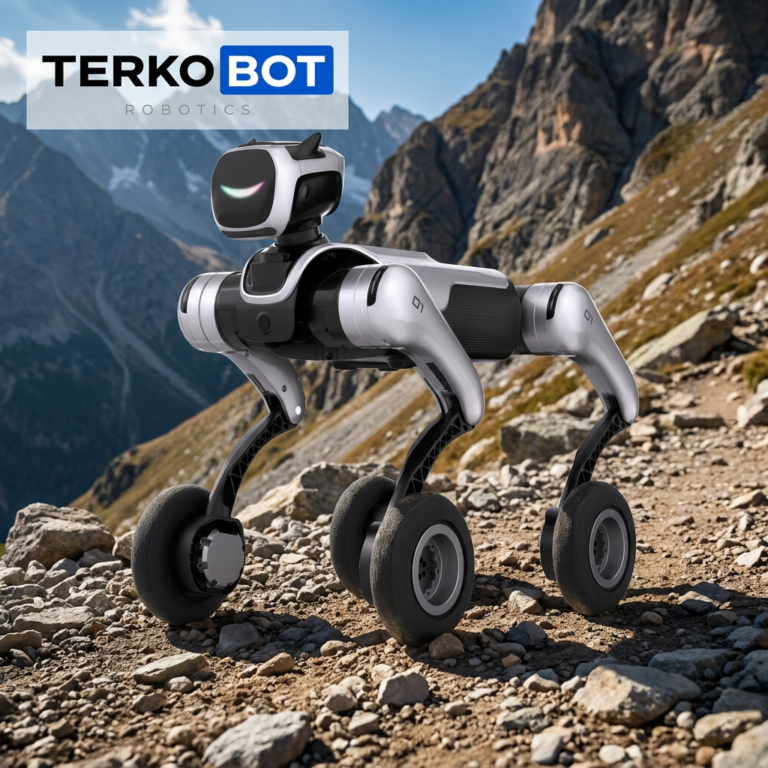 | 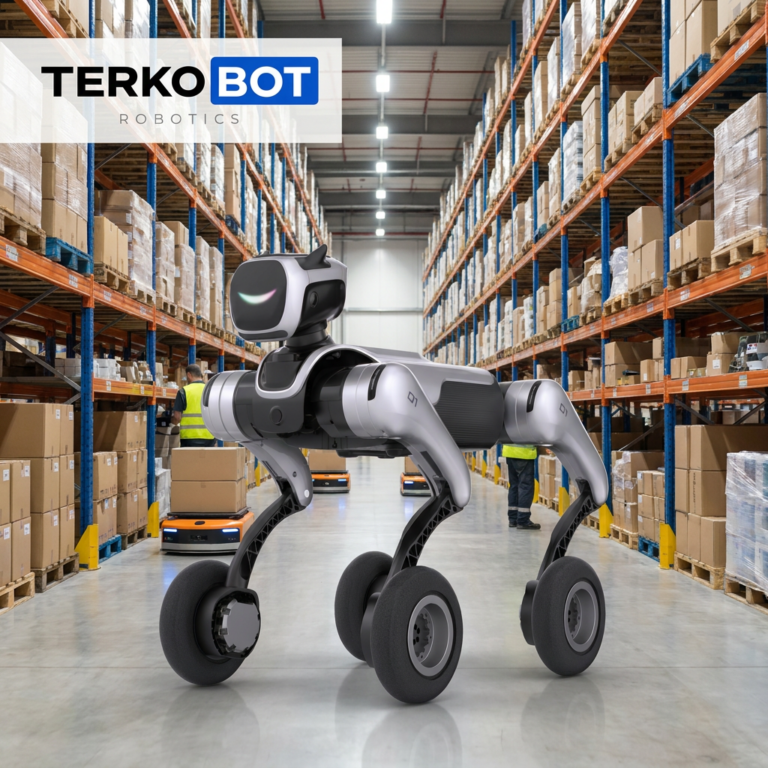 | 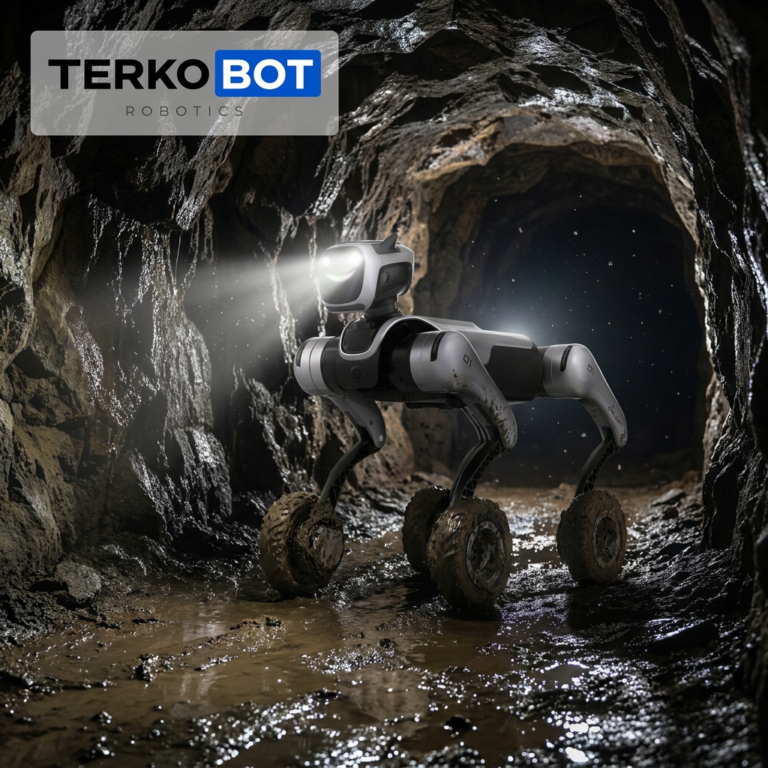 | 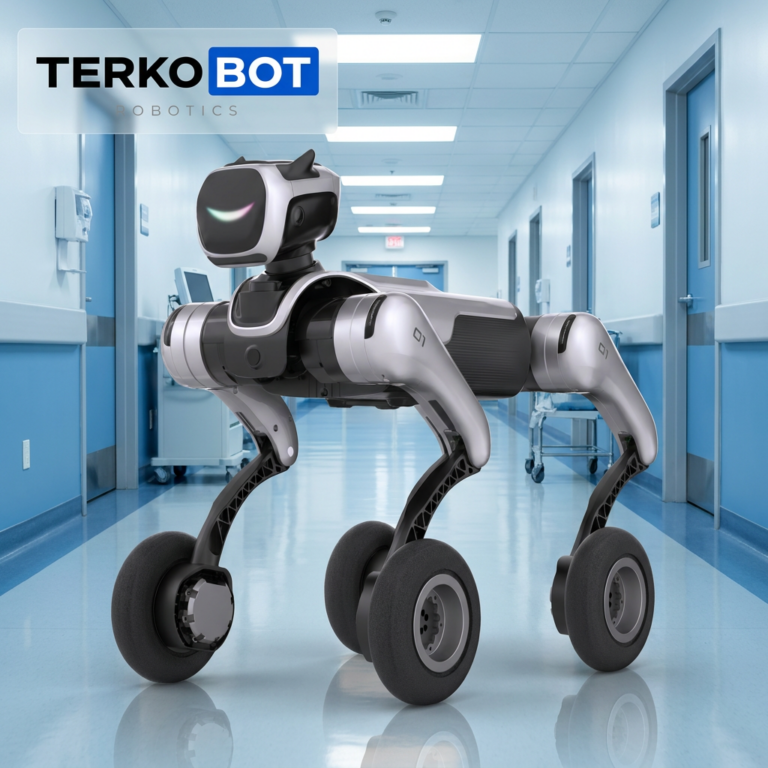 |
FAQ
Q1:What is MagicDog-W?
MagicDog-W is a wheeled quadruped robot that combines wheel rolling with quadruped gait motion. It supports posture control, payload expansion, environmental sensing, and robotics development.
Q2:What is the maximum speed?
The supplied materials list a movement speed range of 0–3 m/s.
Q3:Does MagicDog-W support SLAM navigation?
The Education Edition materials list SLAM navigation control services, 2D / 3D LiDAR, and multiple vision sensing modules for SLAM, mapping, and navigation algorithm development.
Q4:What programming languages are supported?
The supplied materials list C++ and Python support, with APIs for robot motion control, sensor control, voice control, status monitoring, and SLAM navigation.
Q5:Is MagicDog-W waterproof?
The current materials list IPX5 for the 2D LiDAR and IP67 for the 3D LiDAR, but do not provide a unified IP rating for the complete robot. Full-system protection capability should be confirmed with the final sales configuration and test documentation.
Customer Case